
Mindset & Confidence for Women in Their 30s
(Reading time: approx. 4 minutes)
Why Do So Many
Women Lose Confidence in Their
30s?
Your thirties aren’t really the decade of lost confidence - they’re the decade of overload.
Everything happens at once: career, relationship, motherhood, financial stability, health, looks, self-development.
You’re expected to hold it all together - while everyone else’s life looks perfectly put-together on social media.
No wonder so many women feel like: “I know what I should be doing - but I just don’t feel good enough to do it.”
Confidence isn’t something you’re born with.
It’s not some invisible force that you either have or don’t.
Confidence is a by-product of experience - not a prerequisite for success, but a result of it.
The Real Definition of Confidence: Experience + Control
Think about when you first learned to drive. You were tense, hyper-focused on every move, every decision deliberate.
Then over time, you could play music, talk, think - it became automatic.
That didn’t happen because you “found” confidence.
It happened because you proved to yourself you could handle it.
Confidence isn’t a feeling - it’s the memory of repeated success.
That’s why your thirties aren’t the decade for finding confidence, but for building it.
So the question isn’t whether you “believe in yourself.”
👉 It’s this: How much have you practiced what you want to feel confident in?

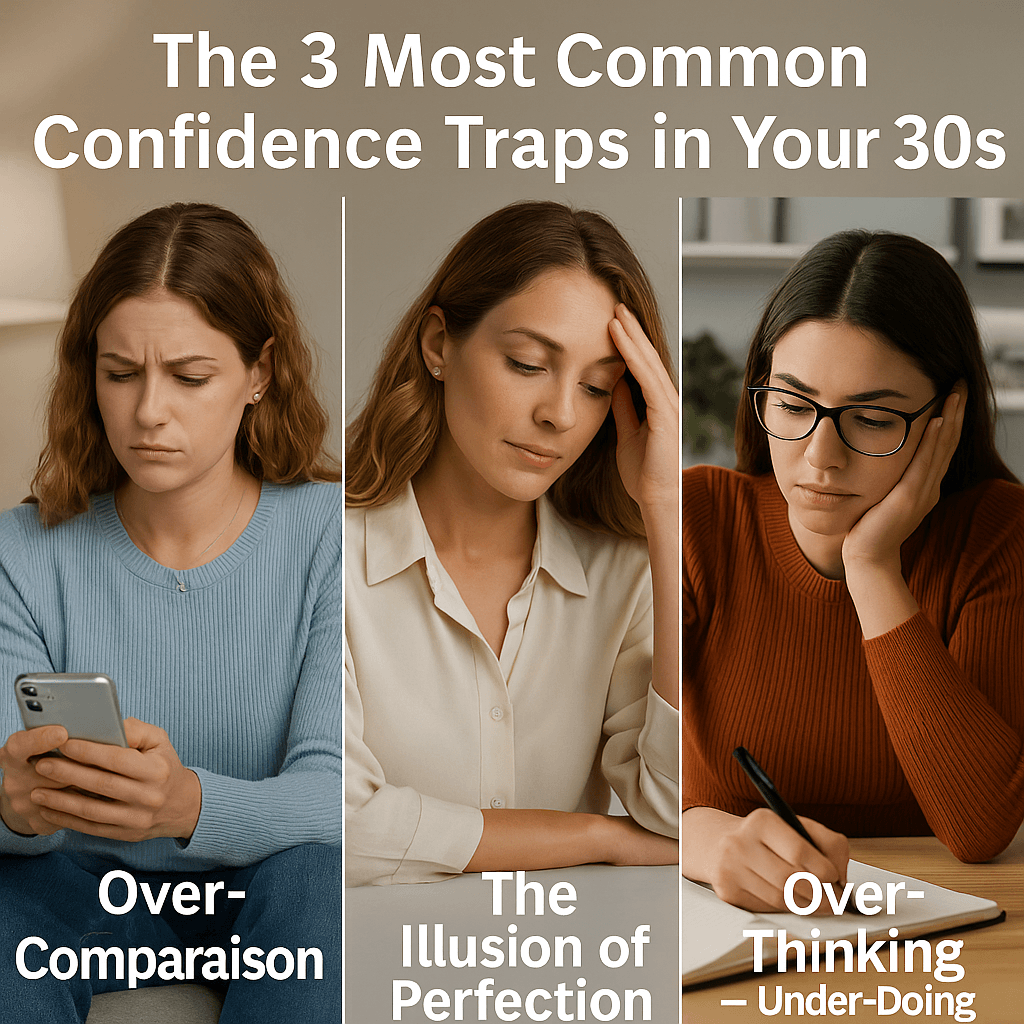
The 3 Most Common Confidence Traps in Your 30s
1. Over-Comparison
Social media is the fastest way to drain your confidence.
Other people’s lives look organized while yours feels chaotic.
But no one posts their doubts, breakdowns, or sleepless nights.
If you measure your progress by someone else’s timeline, you’ll always feel behind - because you’re not even playing the same game.
💡 Mini exercise: For one week, write down one way you were a little better today than yesterday.
Not compared to anyone else - just yourself.
2. The Illusion of Perfection
“I’ll start when everything is finally in place.”
That sentence is the most sophisticated form of procrastination.
Everything will never be “in place” - but once you act, things begin to align. Certainty isn’t a prerequisite. It’s a side effect.
💡 Mini exercise: Pick one thing you’ve been putting off. Take the smallest possible first step.
The goal isn’t the result - it’s simply to move the system forward.
3. Over-Thinking - Under-Doing
Many believe that if they analyze enough, they’ll make better choices.
But analysis doesn’t build confidence - it builds hesitation.
Action brings experience.
And every experience, even a failed one, builds confidence because it proves:
“I handled that. I can handle this too.”
💡 Mini exercise: Keep an “Action Log.”
Each day, write down one thing you completed - even if it was small.
After a week, you’ll see how far you’ve actually moved.
The Implementation Mindset:
Think Like a Doer
Information is no longer the missing piece.
Everyone knows what to do - few actually do it.
Confidence doesn’t come from knowing the theory. It comes from testing it in real life.
The “implementation mindset” means deciding that:
you stop over-analyzing,
you stop waiting to feel “ready,”
and you act while you learn.
True confidence isn’t about being flawless.
It’s about having the flexibility to adapt when things aren’t perfect.
Action builds identity - every small act reshapes how you see yourself.
The Mental Framework:
Knowledge → Responsibility → Control
If you want to remember one clear logic, let it be this: KRC.
These are the three interconnected pillars of confidence:
K = Knowledge – Understand what’s happening to you. Don’t just feel it - see the patterns.
Because without knowledge, there is no real responsibility - and no real control.R = Responsibility – Without knowledge, responsibility turns into guilt.
But when you understand what’s really happening, responsibility becomes a source of strength, not pressure.C = Control – Without knowledge, control becomes random.
But when you see the patterns, you can make conscious choices and direct the outcome.
KRC isn’t three separate ideas - it’s a process:
Knowledge creates the foundation for responsibility, and responsibility creates the path to control.
That’s the chain that builds stability - and with it, real confidence.
It doesn’t come from external validation, but from the quiet knowing that you understand what you’re doing and stand behind it.

What It Really Means to Be a Confident Woman in Your 30s
It doesn’t mean you always know the answer.
It doesn’t mean you never feel fear, or that everything works out.
It means you keep going even when the end isn’t clear.
Confidence isn’t the absence of doubt - it’s the ability to move forward despite it.
Your thirties are not about proving yourself.
They’re about integrating your experiences.
Not about searching for confidence, but about building it - one decision, one step, one day at a time.
And when you start practicing this mindset, you’ll notice:
life didn’t get easier - you got stronger.
Next Step
If you want to not only understand this but live it every day,
join our weekly email series - where you’ll get short, actionable exercises designed to help you build mindset and confidence that lasts.
Join our free weekly email series for women in their 30s - where we turn life’s challenges into clear, doable action plans.
Read similar blog posts here: Click here
Join the circle of women in their 30s:
Keep the momentum going — read this next post that builds on everything we’ve just covered.

Reset Your Body - Unlock Your Decade.
Your 30s aren’t about trying harder - they’re about fixing what’s draining you.
Start your 3-Week Body Reset and bring back the calm, steady energy that makes every goal easier.
✅ Simple foods - clean results.
✅ Balanced electrolytes - deep sleep.
✅ Real focus - zero crash.
You’ll feel the difference in
3 weeks - and you’ll know exactly what your body truly needs.
The Health – Tips – Technology Team

Our mission is simple:
to help you feel great in your own skin.
Follow us
Created with © systeme.io